
BRIGADIER GENERAL
ROBERT HEBER VAN VOLKENBURGH
COMMANDING OFFICER 40TH COAST ARTILLERY BRIGADE
IN AUSTRALIA DURING WWII
Brigadier General
Robert Heber Van Volkenburgh was an important but rather
overlooked American antiaircraft commander in the early Southwest Pacific Area SWPA campaign,
closely associated with General
Douglas MacArthur, Port Moresby, the proposed Buna
operation called Providence, and later the American
antiaircraft organisation headquartered in Brisbane.
1. Who was Van
Volkenburgh?
Robert Heber Van
Volkenburgh was born in Detroit on 5 February 1890 and
graduated from the U.S. Military Academy at West Point in
1913. He was a career Coast Artillery Corps officer
specialising in coastal and antiaircraft defence.
His
pre-war career is significant because he had unusually broad
staff and technical experience. He served on the War
Department General Staff, attended the Naval War College,
commanded Coast Artillery units in Hawaii, and was the
antiaircraft artillery officer of the Fourth Army before the
Pacific War.
His
promotion to temporary Brigadier General was authorised in
September 1941, just before the United States entered the war.
The Congressional Record identifies him as Colonel Robert
Heber Van Volkenburgh, Coast Artillery Corps, appointed to
Brigadier General.
2. His
Australian connection begins with the 40th Coast Artillery Brigade
Van
Volkenburgh commanded the 40th
Coast Artillery Brigade from 17 November 1941 until 28
August 1944 according to the detailed U.S. General-Officer
chronology.
The 40th Coast Artillery
Brigade was one of the American antiaircraft formations
associated with the defence of the Southwest
Pacific Area SWPA from the very beginning of the Pacific
War.
The
following units boarded HMT Queen Mary at Boston,
Massachusetts on 18 February 1942:-
40th Coast Artillery Brigade
(Anti-Aircraft)
Headquarters and
Headquarters Battery
94th Coast Artillery
(Anti-Aircraft)
Headquarters and
Headquarters Battery
1st Battalion
Headquarters and
Headquarters Battery
‘A' Battery
'B' Battery
'C' Battery
'D' Battery
2nd Battalion
Headquarters and
Headquarters Battery
‘E' Battery
'F' Battery
'G' Battery
‘H' Battery
3rd Battalion
Headquarters and
Headquarters Battery
‘I’ Battery
'K' Battery
'L' Battery
‘M' Battery
Medical Detachment
101st Separate Coast
Artillery Battalion
Headquarters and
Headquarters Battery
'A' Battery
‘B' Battery
'C' Battery
'D' Battery
Medical Detachment
104th Separate Coast
Artillery Battalion
Headquarters and
Headquarters Battery
'A' Battery
‘B' Battery
‘C' Battery
'D' Battery
Medical Detachment
The 40th Coast Artillery
Brigade (AA) arrived in Sydney, Australia on the HMT
Queen Mary as part of Task Force 5691 (East) in the early
evening of 28 March 1942.
They
boarded troop trains near the wharves and departed for
Brisbane in south east Queensland arriving there on the
evening of 29 March 1942. The Brigade proceeded to Camp Doomben and
temporary Headquarters were established at Ascot Racecourse the
following day.
Headquarters United States Army
Forces in Australia USAFIA assigned Brig Gen Van
Volkenburgh as Commander of Northeastern Antiaircraft
Artillery Command (NEAAC) and gave him the following troops:-
UNITED STATES ARMY
94th CA (AA) Regiment
208th CA (AA) Regiment
101st CA Bn (AA) (Sep)
104th CA Bn (AA)
(Sep)
AUSTRALIAN MILITARY
FORCES
6th AA Btry,
RAA (8 – 3.7” guns) – Brisbane
16th AA Btry, RAA (8 – 3.7” guns) – Townsville
154th Lt AA Btry, RAA (12 – 40mm guns) – Brisbane
***
2/9th Aust Lt AA Btry, RAA (12 – 40mm guns) –
Townsville
56th AA Coy, RAE (8 – Slt stations) – Brisbane
68th AA Coy, RAE (8- Slt stations) – Brisbane
71st AA Coy, RAE (8 Slt stations) – Townsville
6th AA Workshop, AAOC – Brisbane
16th AA Ordnance Workshop, Hvy, AAOC – Townsville
56th AA Slt Ordnance Workshop, Hvy, AAOC - Brisbane
*** Whilst the 154th Lt
AA Battery is shown in this above list from an official
history of the 40th Coast Artillery Brigade, it was not named
as the 154th Lr AA Battery until July 1942, previously being
"A" Battery of the 110 LAA Regiment.
On 1
April 1942 Brig Gen Van Volkenburgh made a reconnaissance of
airfields and other important installations in northern and
western Queensland. He also travelled to Port Moresby. On his
return to Brisbane he recommended that one automatic Weapons
Battalion be sent to Port Moresby to stop the low-level
Japanese aircraft that were regularly making harassing attacks
on Port Moresby. The 101st
CA Battalion (AA) (Sep) was sent to Port Moresby on 26
April 1942.
On 8 May
1942 Headquarters NEAAC relocated to the 4th floor
of the Rich Building
on the corner of Wharf and Adelaide Streets in the Brisbane
city area. The Rich
Building also provided living and messing facilities for
the enlisted men, a complete medical and dental clinic and a
complete photographic laboratory. The officers were quartered
at the Montpelier Hotel
on nearby Wickham Terrace.
In July
1942, General Douglas MacArthur
selected Van Volkenburgh to command a special task force
associated with the proposed occupation of Buna, on the north
coast of Papua. The operation was given the code name
PROVIDENCE.
The 40th Coast Artillery
Brigade (AA) and presumably NEAAC and Brig Gen Van
Volkenburgh moved from Brisbane to Townsville by rail on 26
July 1942 arriving in Townsville on 29 July 1942. They camped
at Camp
Cutheringa in Townsville.
Brigadier
Burrows of 1 Aust Infantry Brigade in the Newcastle area
received a signal to advise that HQ 1 Aust Infantry Brigade
and the Signal Section would come under the control of
Brigadier Van Volkenburgh, Commander Northeastern Antiaircraft
Artillery Command (NEAAC) in Townsville from 24 July 1942. In
a further signal Brigadier Burrows was directed to report to
Brigadier Van Volkenburgh in Townsville as soon as possible
for “personal liaison”.
Operation
PROVIDENCE was eventually cancelled due to the Japanese
occupying the area before PROVIDENCE could be activated. See
more information on PROVIDENCE further below.
On 27 September 1942,
Brig Gen Van Volkenburgh and Captain Cleveland as Aide-de-camp
were placed on detached service and the General was assigned
to command the Joint
Operations Overseas Training School JOOTS at Port
Stephens in New South Wales.
Brig Gen Van
Volkenburgh and his aide returned from JOOTS on 15 March 1943
and the General resumed command of the 40th Coast Artillery
Brigade (AA) which by then was located at Port Moresby.
The General, by agreement with New Guinea Force, assumed
command of AA defences in New Guinea, except for Merauke,
which was under the control of the First Australian Army. His
command was known as Antiaircraft Defense Command, New Guinea
Force.
Whilst Van Volkenburgh
went on leave from 20 January 1944 until 4 February 1944,
Colonel H.L. Chandler assumed command.
3. He
was much more than an antiaircraft commander
Brig Gen
Van Volkenburgh met with General
Douglas MacArthur on two occasions. Initially for a
short while at noon on Saturday 18 April 1942 in the General’s
GHQ SWPA in Collins Street in Melbourne and again at noon on
Tuesday 9 March 1943 in his relocated GHQ SWPA in Brisbane.
In July
1942, General Douglas MacArthur
selected Van Volkenburgh to command a special task force
associated with the proposed occupation of Buna, on the north
coast of Papua. The operation was given the code name
PROVIDENCE.
The
objective of Providence was not initially to launch a major
ground offensive against Buna. It was to:-
The U.S.
Army history says that Van Volkenburgh was to command Buna
Force while it was moving toward Buna, with an Australian
Brigadier subsequently taking command once the force reached
the objective.
An ANU
study of the campaign makes the chain of command particularly
clear. The task force was established separately from the
Allied Land Forces and reported directly to MacArthur as Commander-in-Chief,
SWPA.
4.
Operation PROVIDENCE
The
planning of Providence took place in July 1942.
An
American-Australian reconnaissance party visited the Buna area
on 10-11 July 1942 and identified the area around Dobodura,
south of Buna, as particularly suitable for a large airfield.
The proposed airfield was to have a runway approximately 7,000
feet long.
MacArthur’s headquarters
subsequently developed the Providence plan.
On 15
July 1942, General
Richard Kerens Sutherland, MacArthur's Chief of Staff,
issued instructions concerning the occupation and construction
of the Buna airfield, and Van Volkenburgh was designated
task-force commander.
The force
was to move in four serials.
The first
included:
The later
elements included:
Brig Gen
Van Volkenburgh’s command was therefore directly involved in
the planned introduction of American antiaircraft and radar
capability into the Buna/Dobodura area.
5.
PROVIDENCE was overtaken by the Japanese
The first
serial was scheduled to leave Port Moresby on 31 July 1942,
with the main operation planned for early August 1942.
But
events moved much faster than Allied planning.
The
Japanese landed in the Buna area on 21–22 July 1942, putting
the Japanese forces between the proposed Allied occupation and
the intended objective. The Providence operation consequently
had to be abandoned.
This is a
fascinating episode because Van Volkenburgh therefore became
one of the American senior officers associated with an
operation that was planned as an offensive penetration north
of the Owen Stanley Range, but which was overtaken by the
Japanese advance.
Instead,
the Allies had to fight the much more difficult campaign that
became the Kokoda–Buna–Gona campaign.
6. His
relationship with Douglas MacArthur
As
mentioned earlier Brig Gen Van Volkenburgh met with General Douglas MacArthur on
at least two occasions, which are documented in MacArthur’s
Office Diary; on 18 April 1942 in Melbourne and again on 9
March 1943 in Brisbane.
There is
another important clue to Van Volkenburgh’s position within MacArthur’s headquarters.
A later
recollection by Van Volkenburgh describes MacArthur discussing
the Battle of the Coral Sea
with his staff. Van Volkenburgh remembered MacArthur’s
theatrical recounting of events and said:-
“I enjoyed every second
of it.”
The
surviving account identifies Van Volkenburgh as MacArthur’s
antiaircraft chief. This indicates that Van Volkenburgh was
sufficiently close to MacArthur’s
headquarters to be part of the general’s senior
operational circle.
7. His
work was closely tied to Australian operations
Van
Volkenburgh’s role sat at an interesting junction between the
American and Australian commands.
The
Providence plan specifically envisaged:-
American command during
movement → Australian command at Buna.
This
demonstrates how early the SWPA
command structure was developing into the hybrid
American-Australian system that became characteristic of MacArthur’s headquarters.
Van
Volkenburgh was therefore involved in one of the early
experiments in integrating:-
8. His
movements in Australia in early 1942
One
particularly valuable contemporary source is the diary of Brigadier General Ralph Royce.
Royce flew to Archerfield Airfield in Brisbane
from Melbourne in a B-17C Flying Fortress piloted by Bob
Northcutt on 9 April 1942. Royce
recorded in his diary that on 10 April 1942 Brigadier General
Van Volkenburgh drove him back to Archerfield
Airfield, after which Royce
flew to Charters Towers in a B-17C Flying Fortress again
piloted by Bob Northcutt. Royce flew
on to Del Monte via Batchelor in the Northern Territory to
lead the famous Royce Mission which
comprised ten B-25 Mitchells equipped with auxiliary fuel
tanks and three B-17 Flying Fortresses which went on to
operate from Mindanao for a number of days carrying out a
series of daring bombing raids on Japanese installations.
General Royce arrived back in Batchelor
in the Northern Territory on 14 April 1942. He returned to
Melbourne via Adelaide the following day arriving at Laverton
at 19:30 hours on 15 April 1942. Royce
met up with Brig Gen Van Volkenburgh again in Melbourne at 3pm
on Friday 17 April 1942.
On 18
April 1942, General Royce picked up
Van Volkenburgh and took him to Seymours for cocktails, and
then picked up Mrs Moulton and took her and Van Volkenburgh to
his house for dinner. Mrs
Beryl Stevenson, General
Brett’s secretary, was also there for dinner.
Brig Gen
Van Volkenburgh is shown in Royce’s diary attending a
conference on Saturday 2 May 1942 and again with his staff on
Tuesday 14 July 1942.
The Royce
Diary entry for Saturday 18 July 1942 reads as follows:-
“…. Col Lars of GHQ
here as chief of staff for Van Volkenburgh – task force CO
for occupation of Buna - ….”
9.
Mentioned in Official Memos
Field
Order No. 3 dated 1 June 1942 shows Van Volkenburgh as
Commanding General for HQ Northeastern A.A.A. Command in
Brisbane.
General
Orders Number 1 dated 13 August 1942 and Field Order No. 5
dated 12 September 1942 show him as Commanding General of the
40th Coast Artillery
Brigade (AA) at APO 922 which was Base Section 2 in
Townsville.
Field
Order No. 6 dated 12 April 1943 through to Field Order No. 34
dated 13 February 1944 show him as the Commanding General of 40th Coast Artillery
Brigade (AA) at APO 929 which was Port Moresby.
Field
Order No. 35 dated 23 March 1944 shows him as the Commanding
General of the 40th
Coast Artillery Brigade (AA) at APO 713-1 which was Base
“E” Nadzab, New Guinea.
10. 14th Anti-aircraft
Command in Perry
House, Brisbane
On
15
November 1943 all anti-aircraft units in the SWPA were assigned to the newly formed
14th AA Command
which remained in Brisbane until 3 July 1944.
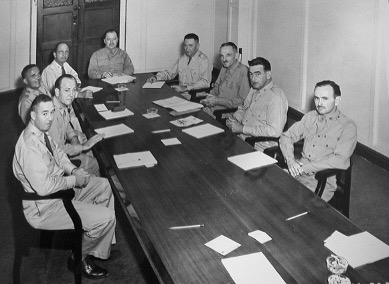
Officers of 14th Anti-aircraft
Command at Perry
House on 29 Feb 1944.
Left to right:- Col A.
E. Baker, Col F. J. French, Brig Gen H. Case, Brig Gen R. H.
Van Volkenburgh,
Brig Gen W. F. Marquat, Col A. E. Colburn, Col H. L. Chandler,
Col C. L. Carter, Lt Col D. C. Sanderson
11. He was still active in the New Guinea theatre in 1944
The
Australian War Memorial states that the Australian War
Cemetery at Lae was officially dedicated on 23 April 1944. The
official party included:
12.
His command changed in August 1944
The
general-officer chronology indicates that Van Volkenburgh
ceased commanding the 40th Coast
Artillery Brigade on 28 August 1944.
He then
commanded the 62nd Antiaircraft Artillery Brigade from 29
August to 2 October 1944.
His
subsequent assignments were increasingly concerned with
antiaircraft training and organisation rather than the
Australian operational theatre.
13.
His Australian/SWPA service earned him the Distinguished
Service Medal
Van
Volkenburgh was subsequently awarded the U.S. Army
Distinguished Service Medal.
The award
citation identifies his service as commanding officer of the 40th Coast Artillery Brigade
from 1941 to 1944 and describes it as exceptionally
meritorious and distinguished service in a position of great
responsibility.
14.
Three overlapping Roles
He appears to have occupied three
overlapping roles:-
A. Senior American
antiaircraft commander
His principal
professional specialty was antiaircraft defence.
B. MacArthur’s
senior AA adviser
He was sufficiently
close to MacArthur to be described as his antiaircraft chief
and participated in the highest-level discussions of air
defence and operations.
C. Special
task-force commander
MacArthur personally
used him to command Buna Force, an unusual temporary formation
established outside the normal Allied Land Forces chain of
command.
ACKNOWLEDGEMENTS
I'd like to thank
Graham McKenzie-Smith for his assistance with this web page.
Can anyone help me with more information?
"Australia @ War" WWII Research Products

|
|
© Peter Dunn 2015 |
Please
e-mail me |

This page first
produced 10 September 2026
This page last updated 11 September 2026


