
ROSS RIVER DOG
KENNELS
BASE QUARTERMASTER, BASE SECTION 2
TOWNSVILLE, QLD
IN AUSTRALIA DURING WWII
Five acres of land near the Hangar at the Ross River Airfield were procured by the Base Quartermaster of Base Section 2, US Army as a site for dog kennels in May 1943. I believe the dog kennels were located on the vacant Crown Land shown on the plan below, just to the east of the hangar across the other side of Stuart Drive (the road to Charters Towers) from the Ross River Meatworks.
Two Enlisted Men, graduates of the War Dog Training School, were placed in charge of the dog kennels. Their duties were to train the dogs as watch dogs for the various Quartermaster warehouses located around Townsville. The brand numbers assigned to Base Section 2 for the registration of all dogs purchased was the following block of numbers - 7 x 00 to 7 x 499.
Scrap meats from Armstrongs Paddock and the 12th Station Hospital at Aitkenvale were saved to feed the dogs at the Ross River Kennels.
It eventually became apparent that the guarding of warehouses using watch dogs had proved unsatisfactory in many instances. When the dogs were locked inside the warehouses, that prevented personnel from entering the buildings. Access for these personnel was essential as they had to work at night time. The delays experienced waiting for dog handlers to arrive were unacceptable. It was eventually decided in about February/March 1944 to abandon the dog kennels.
All of the dogs were
disposed of to the Base Veterinarian who turned the dogs over to
the Australian health authorities for the removal of heart
worms. These worms were then used in the preparation of
diagnostic tests for the detection of filiariasis among the
troops. No additional guards were required to replace the former
duties carried out by the watch dogs.
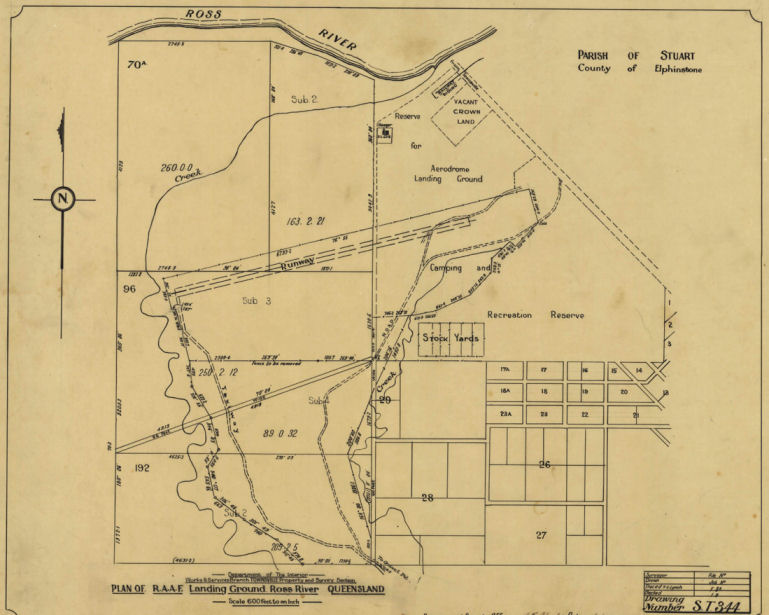
Plan:- NAA
Plan of Ross River Airfield dated 8 Nov 1943
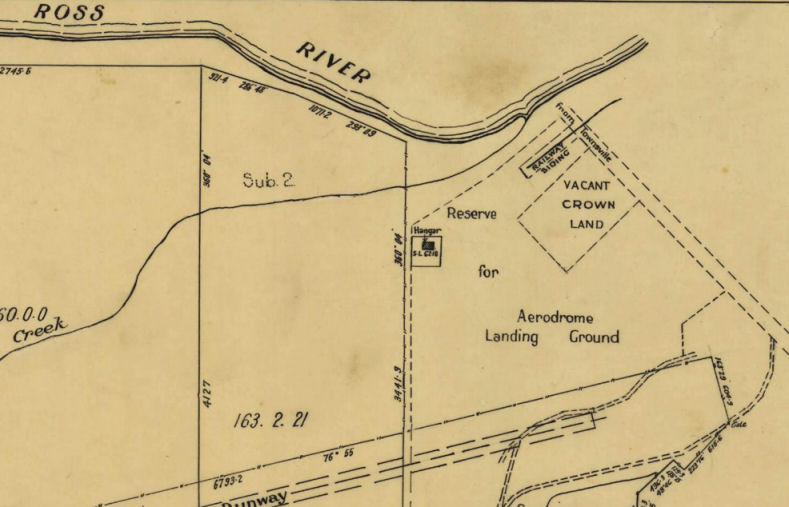
Plan:- NAA
I believe the Base QM Dog Kennels were located on the Crown Land to the east of the hangar
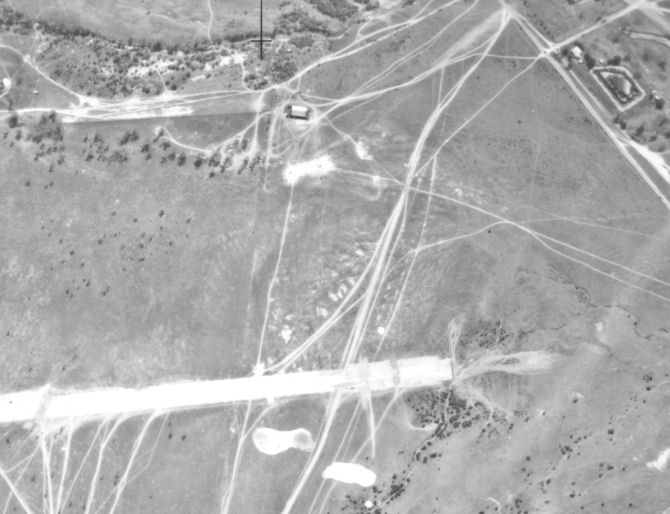
The Hangar at Ross River Airfield can be seen in this July 1941 aerial photo
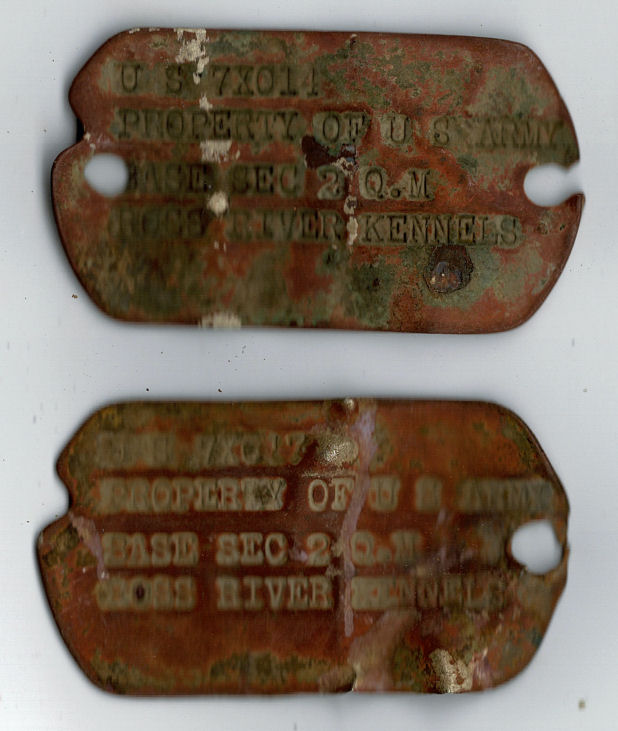
Photo:- Nick Shailer 31 May 2023
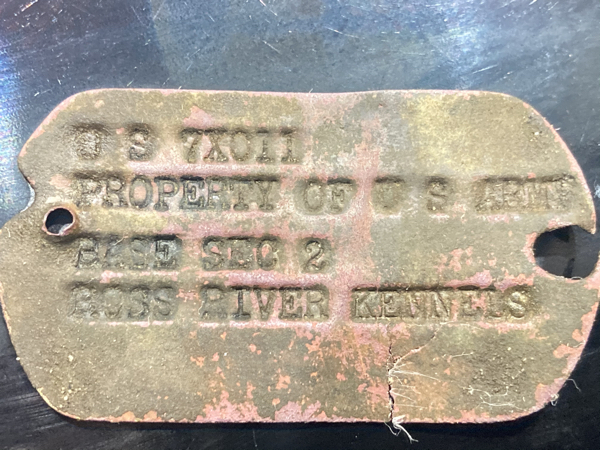
Two dog tags found
whilst clearing a house
Nick Shailer was given
the above two Dog Tags on 31 May 2023. They were found while
clearing a relative's house. Nick thinks these would have been
on military dog collars. They are stamped US 7X014 and US 7X017,
PROPERTY OF U.S. ARMY, BASE SEC 2 Q.M., ROSS RIVER KENNELS.
These registration numbers fall within the block of numbers
assigned to the dogs at the Base Quartermaster Base Section 2,
Ross River Dog Kennels as listed above.
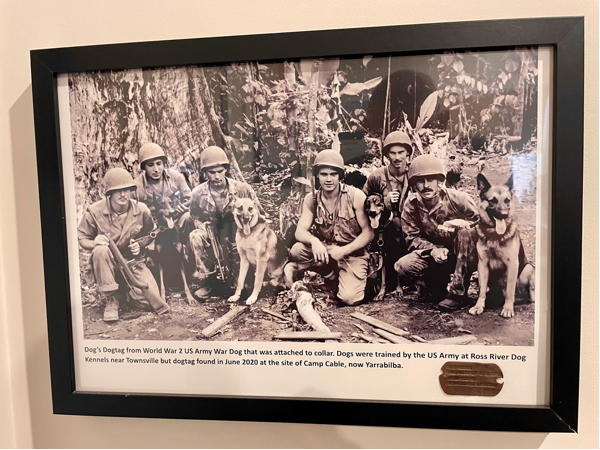
The U.S. Army’s overall War Dog Program formally began on 13 March 1942. Dogs were obtained largely through the civilian Dogs for Defense program and trained by the Quartermaster Corps. Ultimately, more than 10,000 dogs were trained for the Army and Coast Guard, with roles including sentry, scout/patrol, messenger and mine detection. But Australia imposed a major restriction. The official U.S. Army history states explicitly:-
“Australia … refused the entry of animals from the
Zone of Interior.”
And more broadly, it recorded that "all U.S. Army dogs from the Zone of Interior were prohibited from entering Australia".
This was not simply an arbitrary Australian regulation. The Australian authorities were extremely concerned about introducing exotic animal diseases. The same restrictions affected U.S. Army horses and mules. The U.S. medical history records that even war dogs and pack animals intended for tactical operations were barred because of the danger of introducing diseases then present in the United States. So US Army War Dogs in Australia had to be obtained locally within Australia.
Six Quartermaster Corps men and eight dogs, including scout and messenger dogs departed the United States in June 1943. They arrived at Brisbane, and transferred to another ship and reached Port Moresby on 29 July 1943. The dogs were not allowed to land in Australia so only transited through Brisbane to New Guinea.
By September -
December 1943, the veterinarian of U.S. Army Base Section 3, Brisbane, was
providing professional veterinary care for 35 dogs assigned to
a Quartermaster unit in Brisbane.
REFERENCE BOOKS
"Base Two - The Bayonet of Australia"
ACKNOWLEDGEMENTS
I'd like to thank Vic Suchocki and Nick Shailer for their assistance with this web page.
Can anyone help me with more information?
"Australia @ War" WWII Research Products

|
|
© Peter Dunn 2015 |
Please
e-mail me |

This page first produced 1 June 2023
This page last updated 4 October 2026


