
DE
HAVILLAND GLIDERS IN THE RAAF
IN AUSTRALIA DURING WWII
Following
the Japanese advance through Malaya and the Netherlands East
Indies, and the bombing of Darwin on 19 February 1942, the
Australian authorities were seriously concerned about the
possibility of a Japanese invasion of Australia. The RAAF
therefore considered that Australia needed its own
troop-carrying glider capability, rather than depending
entirely upon Britain or the United States.
In
March 1942, the Department of Air issued a requirement for a
total of 126 troop transport gliders and Specification 5/42
was issued for a small seven-seat glider.
The
project was given to de Havilland Australia and it was
particularly significant because the DHA glider was
effectively de Havilland Australia’s first indigenous aircraft
design. DHA had previously been assembling and manufacturing
de Havilland designs under licence, including Tiger Moths and
Dragons.
The
glider was something different: an Australian design produced
in response to an Australian military requirement. The chief
designer was Martin Warner.
Because
DHA was already heavily committed to wartime production, the
glider project was undertaken using subcontractors and unusual
manufacturing arrangements. The prototypes were constructed on
the fifth floor of the Bradford Cotton Mills building at
Camperdown, in Sydney.
The
aircraft was essentially a large wooden box-like
troop-carrying glider, but it was considerably more
sophisticated than its rather simple appearance might suggest.
Some of its characteristics were:-
The
windscreen and window arrangement drew heavily upon the de
Havilland DH.84 Dragon, which DHA was already manufacturing.
The undercarriage was particularly simple: a single main
wheel, with a substantial nose skid and tailskid. That was
entirely appropriate for an aircraft intended to land on
relatively rough forward strips.
Two
prototypes were built. They were initially known as:-
EG.1 — Experimental Glider 1
EG.2 — Experimental Glider 2
They
subsequently received the RAAF serials:-
A57-1001
A57-1002
The
first prototype flew on 14 June 1942. It was initially tested
at RAAF Richmond, with a Fairey Battle acting as the tug. The
second prototype followed later in 1942.
There
is some disagreement between some records as to the proposed
use for this glider. One source indicated that the glider was
intended to carry small groups of troops into areas threatened
by Japanese invasion. Another source, which came from people
involved with de Havilland, suggested a somewhat different
role: namely carrying fighter-support equipment, engines, guns
and personnel to forward fighter bases.
The
DHA was far too small to be an Australian equivalent of the
later American CG-4A or British Horsa. It could carry only six
passengers plus the pilot.
Consequently,
describing it simply as an “invasion troop glider” can give a
misleading impression of its intended military usefulness. A
more sensible interpretation is that it was a small tactical
transport glider, capable of carrying a handful of personnel
or a useful load of equipment into a forward area.
The
RAAF subsequently ordered an improved production version of
the glider which was designated DHA-G.2.
Six
G.2s were built and assigned RAAF Serials A57-1 to A57-6. The
G.2 differed from the prototypes in several ways.
Most
importantly, its wing was redesigned so that it could be
broken into three sections. This made the aircraft
substantially easier to transport by road or other means to an
operational area. The production aircraft also had a somewhat
different fuselage and revised wing. The prototypes had
approximately a 59-foot span, whereas the G.2 had a span of
approximately 50 ft 6 in.
The
six G.2s were constructed in Sydney in the Slingo &
Williams building, which had previously been a toy factory.
They were then assembled at Mascot.
The
first production G.2 flew on 20 March 1943. It was delivered
to the RAAF on 6 May 1943, with the remaining aircraft
following in July 1943.
By
the time the G.2 entered service in 1943, the immediate
invasion threat had diminished substantially. This is probably
the most important reason why the DHA glider never became an
important operational aircraft.
At
the same time, Australia was obtaining much more capable
aircraft from the United States. The Douglas C-47 Dakota had
already proven that it could transport considerably larger
loads and could operate without the limitations associated
with glider operations. The Americans were also supplying Waco
CG-4A Hadrian gliders.
Consequently,
there was little reason to embark upon mass production of a
small Australian glider. Only six G.2s were ever produced.
A57-1
This
glider became by far the most historically significant
aircraft. It ultimately became the GLAS II suction-wing
research aircraft (see below).
A57-2
to A57-6
The
remaining five were delivered to No. 2 Aircraft Depot at
Richmond in July 1943. In August they were transferred to No.
1 Air Observers School at Evans Head, where they were largely
stored. Their subsequent histories demonstrate just how little
the RAAF ultimately needed them.
A57-3
This
glider was occasionally flown behind C-47 Dakotas from
Richmond, apparently continuing into the post-war period.
A57-4
It
became an instructional airframe.
A57-5
It
was transferred to the CSIR Division of Aeronautics (CSIR-DA)
for research purposes.
The
G.2 was not a large aircraft. Approximate specifications are:-
Characteristic
DHA-G.2
Crew
1
Passengers
6
Length
33 ft /
10.05–10.06 m
Wingspan
50 ft 6 in /
15.39 m
Wing area
332 sq ft / 30.84 m²
Empty weight
1,450 lb / 658 kg
Loaded weight
3,250 lb / 1,474
kg
Maximum free-flight
185 mph / 298 km/h
speed
Maximum towing
130 mph / 209
km/h
speed
Stalling speed
about 48 mph / 77 km/h
Maximum diving speed
about 48 mph / 77 km/h
For
a seven-seat wooden glider, the performance was quite
respectable.
After
the war, glider A57-1 was given a completely new lease of
life. Australia had developed considerable interest in
boundary-layer control and the possibility of using suction to
maintain smooth airflow over an aircraft wing.
The
concept was to suck air through extremely small openings in
the wing surface. The objective was to delay flow separation
and consequently improve the aerodynamic characteristics of
the wing.
A decision was made
in 1946 to use A57-1 for this work. The aircraft was rebuilt
with an experimental Griffith-type suction wing.
The
resulting aircraft became known as the GLAS II. This is an
acronym associated with the Griffith/Glauert-type suction-wing
research.
The
modified A57-1 received a 96 hp Ford V-8 Mercury 59A engine.
The engine did not primarily exist to propel the aircraft.
Instead, it drove a centrifugal blower which generated the
suction required for the experimental boundary-layer-control
system.
So
the aircraft effectively became a flying laboratory. Its
engine was there principally to operate the aerodynamic
experiment.
The
GLAS II experimental wing had a span of approximately 48 ft
9 in (14.88 m). The wing incorporated very closely spaced
slots through which air could be sucked from the boundary
layer.
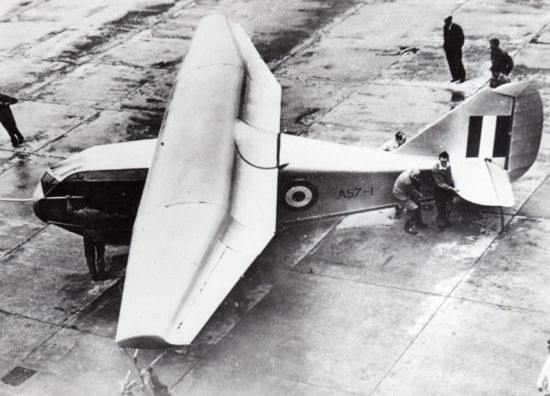
Glider
A57-1 with the modified GLAS II wing
The
idea was extremely ambitious. If the boundary layer could be
kept attached to the wing, engineers hoped that aircraft could
operate with:-
The
Australian work was therefore not merely an experiment with
the DHA glider. It was part of a much wider post-war
investigation into boundary-layer control and laminar-flow
aerodynamics.
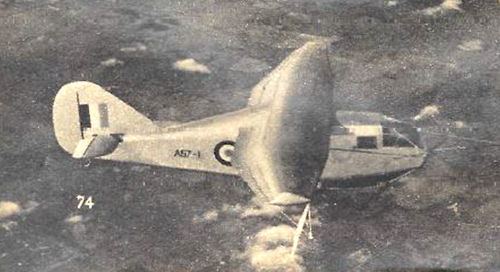
Glider
A57-1 with the modified GLAS II wing
Initial
tests involved the aircraft being positioned behind the
slipstream of an Avro Lincoln. Actual flight testing behind a
Dakota began on 26 October 1948. The research program
ultimately involved approximately 49 flights, according to
Australian aircraft history sources.
There
were considerable technical difficulties. One of the major
problems was surprisingly mundane. Insects and other foreign
matter contaminated the wing’s suction slots and disrupted the
carefully controlled airflow. The experimental system
therefore demonstrated both the potential and the practical
problems of suction boundary-layer control.
The
GLAS II experiment did not simply demonstrate that the DHA
design was unsuccessful. Rather, the research showed that
maintaining the extremely clean wing surface required by the
suction system was a serious operational problem.
The
contamination issue was particularly troublesome. Interest in
the concept subsequently declined. Other much more ambitious
Australian projects were being considered, including the GAD-4
suction-wing glider and even a proposed 72-passenger all-wing
aircraft. Neither was built.
A57-1
continued in experimental use into the early 1950s. The GLAS
II program was eventually terminated. The aircraft was offered
for disposal on 17 December 1952. By then the DHA G.1/G.2 had
disappeared completely as an operational aircraft type.
Thus
the entire production run amounted to:
2 G.1 prototypes + 6 G.2 production
aircraft = 8 aircraft.
Can anyone help me with more information?
"Australia @ War" WWII Research Products

|
|
© Peter Dunn 2015 |
Please
e-mail me |

This page first
produced 1 November 2026
This page last updated 1 November 2026


